Quarterly Insights - Q1 2026
🌱 Quarterly Market Update: Navigating a Geopolitical‑Driven Quarter
This past quarter delivered two unexpected geopolitical shocks, shifting investor attention away from the Federal Reserve and AI and toward global instability. As is often the case, the events no one predicts become front‑page news, while yesterday’s headline fades quickly. The quarter opened with a brief conflict in Venezuela and closed with a still‑unfolding conflict in Iran. While unsettling, these moments reinforce why we invest the way we do: not by forecasting shocks, but by building portfolios designed to withstand them.
Energy Markets: A Big Shock, but a Familiar Pattern
The conflict in the Middle East created one of the most dramatic energy disruptions in years. Roughly 20% of the world’s oil passes through the Strait of Hormuz¹, so any instability there tends to ripple across global markets.
Even though the U.S. has been energy independent since 2019², we still feel the effects of global supply disruptions. Oil prices jumped from around $60 to over $100³ in a matter of weeks.
Historically, energy‑driven inflation tends to fade faster than other types. In fact, a Capital Group study found that since 1990, markets have risen an average of 12% after geopolitical oil disruptions⁴.
Equities: Volatile Headlines, Surprisingly Steady Markets
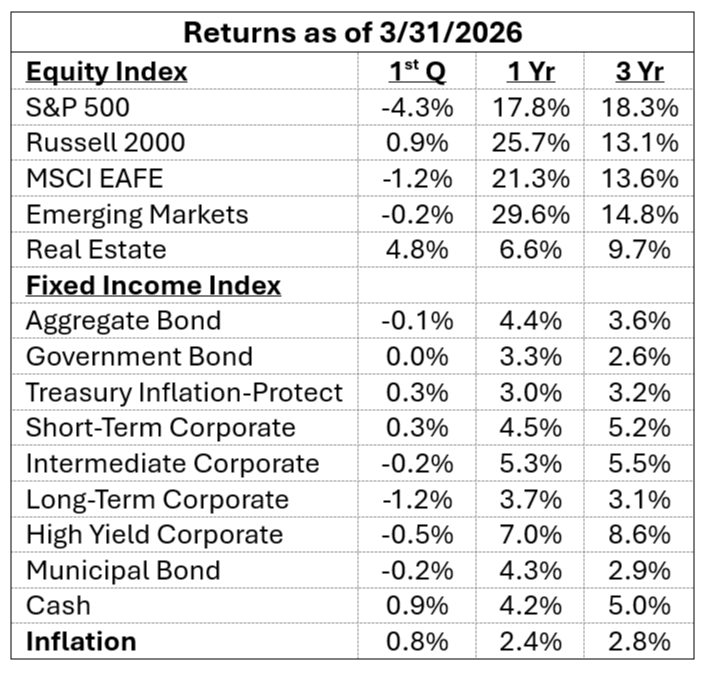
Given the news flow, you might expect a steep market drop. The S&P 500’s biggest decline was 8.9% on March 30th, though the number of days the market was up versus down was somewhat balanced. The S&P 500 finished the quarter down just over 4%.
Small‑ and mid‑cap stocks actually ended the quarter in positive territory, though they softened in the final month. International stocks dipped slightly but briefly entered correction territory as the dollar strengthened.
Diversification played a big role this quarter. Real estate, energy, and value‑oriented sectors helped offset volatility in tech and financials. After several years of strong returns, periods of correction are not only normal; they can create opportunity and restore long‑term market balance.
Fixed Income & Private Credit
Bonds were mostly flat for the quarter. Rates drifted lower early on, then spiked to 4.4% on the 10‑year Treasury⁵ as the Iran conflict escalated. That move helped counter rising inflation expectations tied to higher oil prices. Expectations for Fed rate cuts in 2026 also cooled. A year ago, markets expected multiple cuts. Now, those expectations have been scaled back⁶.
Private credit has also been getting more attention lately, and not always for the best reasons. Private credit is simply lending that happens outside of banks and public bond markets. Instead of issuing a traditional bond, companies borrow directly from private lenders. As the quarter unfolded, parts of the private‑credit market experienced some strain - particularly those that were lending to technology companies who are navigating a changing AI landscape. Private Credit firms like Blue Owl, Blackstone, Apollo and others saw an uptick in withdrawal requests from certain funds, creating pockets of stress in areas that are less liquid and slower to adjust.
It’s important to keep this in perspective. What we’re seeing is largely contained within private, illiquid markets, where valuations don’t reset as quickly and investor flows can be more sensitive. This is very different from the public bond market, which has remained relatively stable. Publicly traded high‑yield spreads are still hovering around 3%⁷, suggesting that investors in the broader credit market aren’t pricing in widespread distress
Putting Volatility in Perspective
Since 1970, the S&P 500 has experienced:
- A 5% decline multiple times per year, on average
- A 10% decline about once per year⁸
Some markets have reached these levels recently, but the S&P 500 has not. Pullbacks are a normal part of long‑term investing and occur for many reasons. While energy disruption dominates the news cycle, the broader economic impact has been limited so far.
Our Focus: Time in the Market, Not Timing the Market
We hope the current conflict resolves quickly. But regardless of how events unfold, our approach stays the same: focus on your long‑term goals, stay diversified, and avoid reacting to short‑term noise.
It is our privilege to serve you and your family. Please reach out anytime, we’re here to help.
Sources
- U.S. Energy Information Administration. Amid Regional Conflict, the Strait of Hormuz Remains Critical Oil Chokepoint. 6/16/2025.
- U.S. Energy Information Administration. How Has U.S. Energy Changed Since 1776. 6/2/2025.
- Yahoo Finance. Crude Oil data from NY Mercantile.
- Capital Group. Selloffs tied to oil shocks have been short‑lived. 3/10/2026.
- FRED, Federal Reserve Bank of St. Louis. 10‑Year Market Yield, as of 3/31/2026.
- CME Group. Probabilities Chart, as of 3/31/2026.
- FRED, Federal Reserve Bank of St. Louis. ICE BofA US High Yield Spread, as of 3/31/2026.
- Morningstar Direct. S&P 500 TR data, 1970–2025, as of 12/31/2025.


